
“How do you recognize an experienced project manager?’
Count the scars.”
(Credit to Cornelius Fichtner – I first heard a version of this in an early episode of the PM Podcast.)
Since 2006, I’ve led IT-projects – some successful, others painful. And every scar and success has taught me something valuable about what works and what doesn’t when managing real-world projects.
Agile and hybrid projects offer flexibility, speed, and adaptability. But they also introduce a new set of risks compared to traditional approaches. If you want to improve your chances of success, you have to deal with these risks early, proactively, and transparently.
Based on the experience I’ve collected over the years, here are my 10 most powerful tips for reducing risk in agile and hybrid projects.
🎧 Prefer to listen? Get the audio summary here:
https://notebooklm.google.com/notebook/eaad40ed-f3ff-4485-80b9-7ff7d000f897/audio
1. The Power of Lessons Learned
Why make the same mistake twice when someone else already did it for you?
Before kicking off a project, go back to similar ones and extract all you can from them. Read old project logs. Call the former project manager. Ask the team what worked last time – and what didn’t. Don’t skip this because you’re in a hurry.
Agile doesn’t mean starting from scratch. It means learning fast. And nothing teaches faster than hindsight from your own or others’ past experiences.
💡 Tip: Set aside dedicated time during project initiation to gather and review past lessons. You’ll be surprised how many traps you can avoid this way.
2. Build a Strong Team
You don’t get a high-performing team by adding fancy new roles or job titles. You build one by bringing in people who’ve done something similar before.
This is especially true in agile and hybrid setups. If your team is inexperienced, pair them with specialists who’ve seen similar challenges and can guide the rest. This isn’t a luxury — it’s a risk-reduction strategy.
👉 If you have a less experienced team, consider a strategic investment: hiring a world-class specialist for a focused period (3 weeks to 3 months). This can significantly accelerate your team’s learning and reduce overall risk.
When you staff your team, prioritize relevant project experience over internal availability.
3. Understand the Customer’s Expectations
“Agile” sounds great – until the customer realizes what it actually means. Many customers say they want agile. But are they ready for it?
Very early in an agile project, you must ensure that your customer understands this simple fact:
- Fixed deadline
- Fixed budget
- Flexible scope
Tools like the Agilometer (from PRINCE2 Agile) can help assess how ready the organization is. (Read more about the agilometer here Are You Ready to Go Agile? Take the Agilometer Test – Excelled Project Management )
Discuss the following with your customer:
- What’s most important to them: Deadline, Scope, or Budget?
- Are they willing to prioritize continuously?
- Will they accept that not everything will make it into the final delivery?
This conversation prevents disappointment later.
📌 Example:
- If you are delivering a project that is tied to a legal deadline (e.g., securing a license to operate), you must focus on delivering the “Must Have” requirements first. You will fail badly if you waste time on “Should Have” or “Could Have” features.
- If your customer has a tight budget, the approach is similar: Deliver the “Must Haves” first. Then reassess if there is room (and money) for anything else.
4. Don’t Skip Solution Design
Just because you work agile doesn’t mean you can skip architecture.
Before development starts, have a high-level understanding of your solution. Document your system architecture and interfaces. Even a short Solution Design document can prevent major integration or technology surprises later.
Think of it as scaffolding: it helps hold the solution together as new parts are added.
Agile teams benefit greatly from knowing the big picture. It enables smarter decisions and smoother iterations.
5. Involve the Users from Day One
Users shouldn’t just be consulted during acceptance testing. They need to be involved throughout the project:
- In writing the requirements.
- In Sprint Reviews.
- In ad hoc demos.
When users feel ownership, you avoid surprises and resistance later. It also leads to better solutions that actually fit their needs.
💡 Tip: Ask users to help define acceptance criteria and demo early functionality to confirm direction.
6. Balance Flexibility with Firmness
Agile is all about being flexible. But in real projects, especially those with tight deadlines or budgets, you sometimes have to be firm.
Some requirements are true “Must-Haves.” When you discover new ones mid-project, you can’t just keep expanding the scope.
Use these tools:
- Track scope changes and their impacts.
- Allocate buffers for changes.
- Be transparent about what gets added, deferred, or cut.
💡 Pro tip: Add a general buffer of around 10% in both time and budget to absorb small scope increases or integration issues. It gives you room to maneuver without constantly renegotiating deadlines or deliverables.
📌 Example: If you have a deadline, deliver the essentials first — and deliver them early. Don’t delay testing or integration by focusing on non-critical functionality.
Being firm isn’t anti-agile. It’s smart risk management.
7. Attack Risky Requirements Early
Don’t leave the big unknowns until the end. If a requirement is uncertain or technically tricky, handle it early. Try a:
- Spike (a time-boxed investigation sprint).
- Proof of Concept (to test tech or approaches).
This gives you clarity before deadlines loom or budgets run out. It also gives you time to adjust.
📌 Example: If you’re integrating with a legacy system, prototype that part first to confirm feasibility.
Transparency allows you to catch issues early — before they become disasters.
Here’s how:
- Demo from production-like environments during Sprint Reviews.
- Use burn-down charts to show progress.
- Track Earned Value (even a simple version).
📌 Example: Earned Value allows you to compare planned versus actual progress — both in time and budget — and quickly detect if you’re drifting off track. Even a basic chart showing Planned Value vs. Earned Value vs. Actual Cost gives clear signals. (See example chart below.)
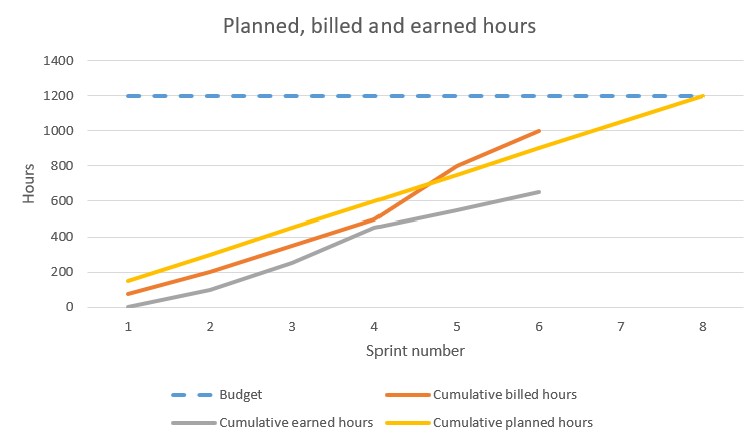
💡 Tip: Don’t hide delays behind vague progress reports. Visual tools like Kanban boards and charts speak volumes.
Make sure everyone (including stakeholders) sees what’s really happening.
9. Do a Formal Risk Analysis
Yes, agile projects need risk analysis too. It’s not just for waterfall.
Do this:
- Identify key risks early.
- Evaluate their likelihood and impact.
- Plan and implement mitigation actions.
- Revisit the analysis regularly.
- Share it with the team and stakeholders.
💡 Tip: This isn’t a bureaucratic exercise — it’s about creating a shared awareness so everyone can help mitigate issues.
📌 Example: Use your steering committee for input to the risk log — they often have insight into business risks or dependencies you’re not aware of. Delegate ownership of key risks to senior team members. It strengthens their commitment — and helps them grow.
10. Be Proactive
You can’t wait for risks to become problems. Agile or not, you need to:
- Think ahead.
- Involve the right people early.
- Make hard decisions in time.
Success in agile and hybrid projects depends less on your ability to adapt after something happens and more on your ability to prevent it before it does.
💡 Tip: Proactive leadership is what separates experienced project managers from the rest.
I will end with this quote:
“All project managers have problems on Mondays.
The average project manager worries about this Monday’s issues.
But the good project manager worries about the risks that might cause problems next Monday.”
(Credit to Cornelius Fichtner – I heard a version of this in one of the early episodes of the PM Podcast. The wording may not be exact, but the point stuck with me.)
Good luck with your projects.🚀