Hybrid Projects

Are You Ready to Go Agile? Take the Agilometer Test

The decision to use an Agile approach, whether pure Scrum, a hybrid like PRINCE2 Agile, or something else, requires careful thought. It is about aligning your project methods with the specific realities of your environment, not just following a trend. If your environment resists Agility, you will face unnecessary friction, delays, and cost overruns. The PRINCE2 Agile Agilometer is a quick, objective tool designed to assess exactly where those risks lie before you commit to the project. What is the Agilometer and Why Should You Use It? The Agilometer is an assessment tool focusing on six key areas of a project environment. Each area is scored from 1 (High Risk / Traditional) to 5 (Ideal Agile Environment). Purpose of the Test: The primary goal is to identify risks and determine the necessary level of tailoring needed for your Agile approach. Remember, a low score does not mean you cannot use Agile; it means you must adjust your governance and controls to mitigate those specific risks. Practical Application: This test gives you direct insight into areas where you need to apply more effort. For example: Low score on Flexibility (Scope): You must increase your focus on strict change control and defining Minimum Viable Product (MVP) boundaries. Low score on Collaboration: You need to mandate more face to face communication and dedicate time to building trust between the customer and the supplier roles. Take the Agilometer Assessment Now Rate your current project or organisation on a scale of 1 to 5 for each of the six factors below. Be honest about your reality, not your aspiration. Remember to be very critical of the output of the test. Does it really apply in your team’s context? Please note that this is only a beta version, and there could be errors in the test. Please let me know if you have any feedback. PRINCE2 Agile Agilometer PRINCE2 Agile Agilometer Assess your project environment’s suitability for an Agile approach (Score 1–5). Calculate Assessment Result Please answer all 6 questions before calculating the result. Assessment Results Total Agility Score: / 30 Visual Assessment (Radar Chart) Targeted Mitigation Advice Focus immediately on your lowest scoring factors. This advice provides a clear strategy for tailoring PRINCE2 Agile to mitigate the identified risks. Ready to Invest in Your Growth? Contact me today for a no-obligation discussion about your project requirements and how I can help you achieve success.   Next steps: Book a consultation | Read my background | View client references

Are You Ready to Go Agile? Take the Agilometer Test Read More »

Why Robust Estimation is the Foundation of Long-Term Project Success

Estimation is not a ceremonial gate a project must pass through; it is the foundation of robust project management. Get it right, and you secure trust, manage expectations, and deliver reliably. Get it wrong, and you risk far more than a simple schedule slip. Good estimation is one of the key skills a project manager and their team must master. The Cost of Bad Estimates: What Happens When You Fail? When a Project Manager is not good at estimating, the consequences cascade, starting small but ultimately impacting careers, finances, and even lives. Career and Company Risk: You can lose your job as a Project Manager, and your company can lose a significant amount of money. Estimation is the basis for every financial commitment, and failure here is non-negotiable business mismanagement. Loss of Stakeholder Trust: Your customers, sponsors, and leadership lose faith in your ability to deliver predictable results. Once trust is broken, every conversation becomes a negotiation, not a collaboration. The Human Cost: The impact is deeply personal for the team. Poor initial estimates create unnecessary stress for the people working on your project. They face continuous pressure to compress the uncompressible, leading to burnout. That stress does not stay in the office; it travels home, and their families feel it. A professional duty to realistic estimation is also a duty to your team’s well-being. The Estimation Dilemma: Understanding Your Role’s Pressure The effort and transparency required for estimation are shaped significantly by your role and the environment you operate within. Different roles face vastly different external expectations regarding estimation efforts. The Supplier PM’s Edge: As a supplier competing against others, you must be extremely careful to make a realistic and rigorous estimate. Your estimate is a key competitive factor, but if it is not solid, you risk having the delivery erode your company’s profit margin and reputation. The Internal PM’s Opportunity: When working with internal resources, there might not be as much pressure for initial perfection. This environment gives you the luxury of being more transparent about your estimates and the associated risks. You can foster a collaborative approach to planning. The Political Project Reality: We must acknowledge the reality of political projects, where the primary focus is often simply securing the initial budget approval. Many stakeholders may know that the first figure is only a fraction of the real cost. The goal is often just to get the project started, hoping to secure additional funding later. A Guiding Principle: Transparency In this article, I will outline precisely how you should act to be the Project Manager who is very transparent and can share estimates and potential risks directly with the stakeholders. This approach transforms estimation from a secretive game into a shared exercise in risk management. 7 Essential Estimation Methods To honour the commitment of transparency, you need a versatile toolkit. As a Project Manager, you must select the method that fits the phase and context of the project. Here are seven of the most impactful estimation techniques, from strategic top-down sizing to detailed bottom-up planning. Guesstimate (AKA Expert Estimate): The fastest method, relying purely on the relevant experience of an expert. It is ideal for an initial, high-level feasibility check, but it should never be relied upon for final commitment. Analogous/Reference Class Estimation (Top-Down): A powerful strategic method for early phases. It forecasts a new project’s duration or cost based on the actual duration and cost of a similar, completed project. The reference class estimate has another great feature: you review the risk and issue register of the project you base your estimates on. Hence, you will learn from other projects. This is one of the cornerstones of professional PM. Resource Loading: A simple and intuitive method. From the milestone plan, you list the roles you need and how much of their time you need, month by month or week by week. You don’t estimate the individual tasks, you estimate the team, and the cost follows. It is a great way to get a first budget when the scope is still a list of headlines. Three-Point Estimation: This involves estimating the Best-Case, Worst-Case, and Most Likely scenarios. These three figures are then often combined using a weighted average to deliver a single, more robust estimate. Challenge yourself to truly read and understand this technique. One of the easy openers for me is that the number you normally give when asked for your best guess is often only 50% certain. A great caveat for stakeholder discussions is that you can ask your stakeholders if they want the 50% plan, the 68% plan (one standard deviation), or the highly confident 95% plan (two standard deviations). This higher certainty level is based on the estimate’s calculated standard deviation, forcing you to proactively include time or budget for the identified risks. Delphi: Several experts estimate anonymously, see each other’s numbers and reasons, and then estimate again. It stops the first number said out loud, or the most senior person in the room, from becoming the answer. The goal is not to make the numbers agree, but to understand why they differ. T-Shirt Sizing: A quick, collaborative technique where teams use relative sizes (S, M, L, XL) instead of hours. This is highly effective for quickly prioritising and sizing a large backlog of work, but you must define a cost range for each size. For example, Small is 0–40 hours. Story Points / Planning Poker: The agile, consensus-based method that estimates the complexity and effort of user stories. It promotes deep team discussion and shared understanding, rather than focusing on hours alone. You can only use this technique if you have the team’s track record, specifically how many story points they normally deliver in a sprint. It can be done on all levels: epic, feature, or user story. You can find a step-by-step guide to each of these methods in my book Beyond the Next Sprint. Pro-Tips for Delivering Estimates Adopting the transparent approach means delivering estimates with context, not just

Why Robust Estimation is the Foundation of Long-Term Project Success Read More »

How to Take Over a Project

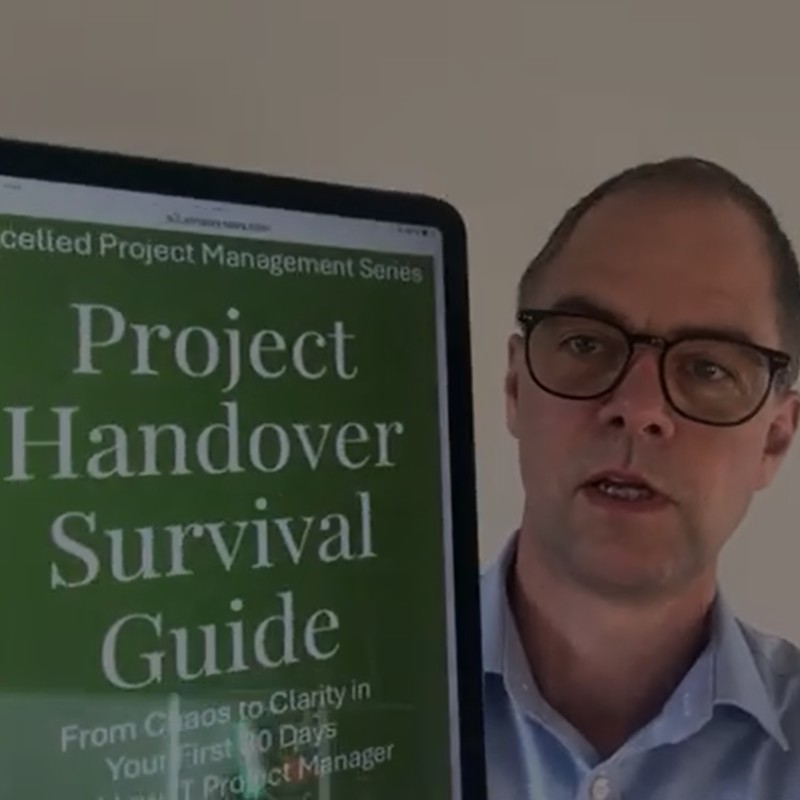
Without Losing Your Mind or Your Reputation 👉 Get the Project Handover Survival Guide here You’ve just been asked to take over a project. Maybe you’re new in the company. Maybe you’ve never worked with this type of project before. Maybe you’re quietly thinking: “Am I too inexperienced for this?” Or maybe: “Am I too old to start over with a new way of working?” The sponsor is watching. The team expects direction. The project is already rolling. You’re now the project manager. And people expect you to make it work. You need to get the team aligned. Understand what the project is really about. See if the plan is realistic. Figure out what the real risks are. And you need to do it fast. When you start doing that – even just the basics – the team and stakeholders will start to trust you. They’ll see you’re the right person for the job. https://youtu.be/iiinzCBfIIM👉 Get the Project Handover Survival Guide here   1. Define Your Leadership – Before the Project Even Starts This is something you can do right now. Even if you haven’t been assigned a project yet. Ask yourself: What kind of project manager do I want to be known as?Are you the one who builds trust fast?Who brings structure?Who keeps things moving when others hesitate? You don’t need 20 years of experience to lead. But you do need clarity. If you’re unclear, people won’t follow you. And if you don’t define your role, others will do it for you – and you may not like how. “Clarity, alignment, stable progress. If we can’t deliver, we act early.” (That’s my personal model. Find yours.) 2. Understand the Role You’re Actually Taking On Every company has a different view of what a project manager is. Don’t assume you’ll be doing the same as last time. Ask what’s expected of you: Are you responsible for delivery or coordination? Do you own the scope, or just the schedule? What decisions can you make alone? Who really has the power in the room? Check the governance model. Talk to the sponsor. Ask the PMO. Align expectations early. It’s hard to correct course once you’re deep in. 💡Pro tip: Be ready to compensate for areas where you can see the project’s governance model is weak, such as business change management or testing. 3. Don’t Focus on Long-Term Plans. Deliver a Quick Win Every project handover is different. And some are messy. You don’t have time to rewrite everything. But you do have time to find small wins. Here’s how I approach the first four weeks: Week 1: Listen. Watch. Absorb. Week 2: Clarify scope. Align with sponsor. Build trust. Week 3: Take action. Simplify. Show results. Week 4: Adjust and improve based on feedback. The most important thing: create momentum. Get something done. Something visible. People don’t trust ideas. They trust action. In my book, “The Project Handover Survival Guide”, I go through this process step-by-step – including tools, checklists, and examples from the field.Here’s what you’ll also find: Appendix: IPMA-Based Complexity Assessment: Use it to assess if your project needs more resources – and explain it clearly to stakeholders. Appendix: How to Use AI Tools in Projects:  Practical advice. No hype. Just ways to save time and stay ahead. Templates for Handovers and Introductions: Emails, summaries, meeting plans. Copy, paste, adjust – and move forward. Why I Wrote the Book I wrote this book because it’s the book I wish I had when I took over my first real project. I learned the hard way. I made the mistakes. I’ve seen what works – and what doesn’t. I don’t want you to repeat my mistakes. I want you to start stronger. Ready to Take Over Your Next Project? Taking over a running project is hard. But it’s also one of the fastest ways to prove your value. 👉 Get the Project Handover Survival Guide here It’s designed to help you lead with clarity, deliver quick wins, and build trust – even when the project is a mess.

How to Take Over a Project Read More »

7 Tips for Executing a Virtual Project Kick-off

In this article, I will provide tips on how to conduct a virtual project kick-off. One of the most enjoyable aspects of a project for me is the kick-off seminar. Previously, it used to be a full-day physical event, where all team members gathered at a venue, ideally located close to where the project deliverables would be used. The seminar was a low-tech affair, with planning and risk analysis done using sticky notes. However, in our current time, it is becoming increasingly rare to have the luxury of conducting a physical kick-off seminar. The reality is that teams are becoming more global, and starting a project cannot be delayed due to the practicalities of gathering an international team. Thankfully, the tools for online collaboration and meetings have improved significantly. As a project manager, you can leverage these tools to create a virtual kick-off that is nearly as effective as a physical seminar. Kick-off Content To get started, let’s review the topics you should cover during the kick-off. My standard agenda for an old-school physical project kick-off seminar looks like this: 09:00 Welcome (Project Manager) 09:10 Seminar purpose and expected outcomes (Project Manager) 09:30 Introduction round (All) 10:00 Purpose – why this project? (Sponsor) 10:30 Project deliverables (Project Manager) 11:00 High-Level Milestone Plan with Workstreams (Project Manager) 11:30 Project organization (Project Manager) 12:00 Roles and responsibilities (Project Manager) 12:30 Lunch 13:00 Break out sessions – Team Leads define minor milestones and estimate work. 14:00 Update milestone plan with minor milestones and dependencies (All) 15:00 Risk analysis (All) 16:00 Update plan with preventive measures from risk analysis (All) 17:00 Share plan and risk analysis with sponsor (Project Manager supported by Team Leads) 18:00 Dinner and team-building (All) Tip 0: Don’t Do a Virtual Kick-off Despite the advancements in online collaboration tools, I still believe that you should try to avoid doing a virtual kick-off. Face-to-face communication, preferably in front of a whiteboard is more effective. However, if a virtual kick-off is inevitable, follow tips below. Tip 1: Set Basic Requirements for Remote Teams To ensure your virtual team works efficiently, ensure they have the necessary technical and physical setup, such as: Computers with webcams. Stable internet connections for virtual meetings with webcams on. An office environment where microphones don’t need to be muted when not speaking. Access and licenses for the collaboration tools you’ll use. Tip 2: Remote Work Agreement Establish clear guidelines for time registration, response times, and media usage. As a project manager, be a role model for adhering to these guidelines. Tip 3: Small Sessions with Preparation and Action Lists Instead of booking a full-day online kick-off, divide the agenda into shorter 1-2 hour sessions. Set clear expectations for participation and engagement, such as turning on webcam. Encourage participants to prepare for sessions by providing input on plans or risk analysis. Record the sessions and share them afterward to accommodate packed schedules and different time zones. Maintain good minutes of meetings with action items, responsible parties, and deadlines. And after the meeting follow-up on the agreed actions. Tip 4: Share Purpose and the “Big Why” via Video Recording Have the project sponsor record a video explaining the purpose and significance of the project. Share this recording with all team members to ensure everyone is aligned with the project’s objectives. Tip 5: Shared Online Planning Tool Use a simple shared online planning tool that allows team leads to update the plan as they receive new information. Excel, MS Project, SharePoint List, Azure Dev Ops, Jira, PowerPoint, or Word are viable options. The project manager defines major milestones, while team leads define minor milestones and report status on them. Tip 6: Online Planning You can do the online planning by following these steps: In a video intro session, introduce the high-level plan with major milestones and workstreams, along with the planning tool. Team leads update the planning tool with minor milestones and dependencies. In a video session, the project manager and team leads update the plan based on team input. Share the plan with stakeholders. Tip 7: Online Risk Analysis Perform the risk analysis online by following these steps:  Store a simple Excel document on your collaboration platform. Request the team to brainstorm risks and add them to the spreadsheet. Conduct a video call to discuss and update the probability and impact of identified risks. Update the plan with preventive measures based on the risk analysis. Bonus tip: Ensuring Personal Connections in a Virtual Setting Virtual meetings often end up being impersonal when meeting participants haven’t met before. To ensure better team collaboration, make the project team get to know each other on a more personal plan through a simple game like a virtual scavenger hunt (https://teambuilding.com/blog/virtual-scavenger-hunt) or asking the meeting participants to talk about what they do in their spare time during the round of introductions. (Thanks to Malte Øster for contributing with this bonus tip.) Conclusion I hope these tips can inspire you and help you to create a successful virtual kick-off for your projects and effectively collaborate with your global team.

7 Tips for Executing a Virtual Project Kick-off Read More »

Make a Big Project Succeed

In “How Big Things Get Done” by Bent Flyvbjerg and Dan Gardner, the authors provide insights and examples on what makes big projects succeed. Drawing on the world’s largest database of big projects, the book offers recommendations to help project managers achieve success. Here are some key takeaways:’Drawing on the world’s largest database of big projects, the book offers recommendations to help project managers achieve success. Here are some key takeaways: Start by Asking “Why?”  It’s important not to jump to a specific solution too quickly when starting a project. Defining the problem or goal first will help you identify the best solution. By asking “why” at the outset, you’ll gain clarity on the project’s purpose and be better equipped to identify and evaluate potential solutions. Maximize Experience  An experienced team and project leader are crucial for project success. While theoretical knowledge is important, experience with similar projects will help you navigate challenges and mitigate risk. Think Slow, Act Fast  When working on a big project, resist the temptation to jump straight into execution. Planning, designing, and prototyping can save time and money in the long run, as it’s easier and cheaper to redesign a blueprint or virtual model than to make changes during construction. Taking time to plan and design thoroughly before starting work will help ensure project success. Reference Class Forecasting Using comparative estimation to estimate project costs and timelines is not new, but Flyvbjerg takes it to the next level with “reference class forecasting.” By grouping projects into reference classes based on similarity, you can more accurately estimate costs and timelines for your own project. Use Reference Classes for Risk Mitigation  Flyvbjerg’s database shows that when big projects go bad, they often go very bad. To mitigate risk, use data from similar projects to identify potential risks and develop a robust risk mitigation plan. Embrace Modularity  Modular projects, such as road, pipeline, wind power, energy transmission, and solar power projects, are less likely to experience budget overruns. By designing your project to deliver small modules or increments, you can get fast feedback and make improvements along the way. Don’t Go for the Biggest, Fastest, or First  The most reliable way to execute a project is to use standard components or modules delivered by an experienced team. Pursuing a project that’s the biggest, fastest, or first can create challenges, such as difficulty in finding an experienced team and inability to use standard components. Conclusion&nbsp With its data-driven approach, “How Big Things Get Done” provides reliable strategies for successful project management. By following these recommendations, you can increase your projects’ chances of success and avoid costly pitfalls.

Make a Big Project Succeed Read More »

10 tips for making a rock-solid project plan

Is it possible to make a rock-solid project plan? All projects have risks. What you can do as a project manager is managing risks in the best possible way. If you do that you can make a robust project plan. In this article I will share my best tips for making a robust project plan, using both agile and more classical project management techniques. In other words, I will give my best shot at answering the question: How do you make a robust hybrid project management plan? The tips below could be used if you need to deliver a customized web portal or a smartphone app. But I am positive they can also be used in other scenarios. Precondition for using the tips You need to do some preparation before you can use the tips below: Execute the project initiation stage, where you capture the requirements for the project and get a clear definition of why you execute the project. As a minimum you must have a backlog of requirements or user stories Some of the tips assume you use Scrum and execute your project in short 1-4 week sprints. The article “Hybrid project management – manage by stages and sprints” outlines how to execute the initiation stage. Tip #1 Include lessons learned Make a list of the lessons learned you want to incorporate in your project. Use your network to collect lessons learned from similar projects. Consider what “lessons learned” you can include from your own previous project. If you decide to make an “incorporated lessons learned” list, you will ensure you consciously reflect on how you can harvest the experience you have access to. It is not only your list, maybe your team, the project board or even the customer can have valuable input for the lessons learned list. Tip #2 Tailor to fit the project environment It will take weeks before you are done planning if you implement all the great ways of planning you can find in the project management literature. Hence, it is essential you tailor your planning and delivery approach to suit your project environment. If you deliver to an internal customer, you might not need to setup a rigid process for change management. On the other hand, if you have an external customer with a tight budget, you need to document changes and focus on prioritization. Tip #3 Three-point estimation Estimate your project using three-point estimation. If you read the theory about this estimation technique you might think it is very complex. But in fact, it is simple to use. Just follow these steps: Find a good excel template for doing three-point estimation or make your own. List all the user stories or the requirements that you need to deliver. Add other work to the list. E.g., fix bugs found under user acceptance test, prepare go live, hyper-care, time for Scrum rituals, automated test, documentation, Scrum master time, project manager time. For each item on the list estimate hours for best-case-, most likely- and worst-case estimate. Decide if you want to use the estimate with 50%, 68%, 90% or 99,7% confidence. If you select 50%, you have a 50% chance of not delivering on time. If you select the 99,7% I think you will have a hard time getting your budget approved. Hence, you must select something in between 50% and 99,7%. Tip #4 Use two estimation techniques It is very hard to predict the future. You will most likely not have foreseen everything in your three-point estimate. Therefore, I will recommend you use two estimation techniques. A good candidate for the second estimation technique is “Comparative estimation”. This technique is quick to use. You compare your project to a similar project that has already been completed. Estimate how many times bigger or smaller your project is compared to the old project. If your project implements 10 new user stories, and the old project implements 20 user stories you could argue that your estimate should be 50% of the actual cost of the old project. If the outputs from the two techniques are similar you don’t need to do anything. If the second estimate is higher than your first estimate, you might need to go back and find out what you missed in your three-point estimate. Tip #5 Prioritize the backlog The simplest way of mitigating risk is to prioritize the backlog. To do this you ask the customer what the most important requirements are, and then you develop them first. You can also use the MoSCoW method, where you ask the customer to prioritize the backlog with one of the following priorities: Must have Should have Could have Won’t have (this time) If you experience that the customer wants to set all requirements to “Must have”, it indicates that there is no flexibility on scope. In this case you should be very cautious on what agile techniques you deploy. Bonus tip: If your project contains technology that is new to your team, you could consider starting the project with a proof-of-concept sprint. If you don’t manage to prove the new concept you can stop the project with a limited loss. Tip #6 Plan sprint where you do nothing Plan that every sixth sprint is not used on developing new features. When you reach the “no-planned-development” sprint there are two possible scenarios: There are no major issues, hence you can use the sprint for education and documentation. You have issues and have not completed as many uses stories as planned. In this case you should use the sprint for catching up to the original plan. Tip #7 Contingency budget You must include a budget for contingencies. If you have the privilege of having a stable experienced team that work in a known domain, and you use known technology, the contingency budget could be as low as 10%. But you will most likely have to pick a higher number, because there are known unknowns and unknown unknowns. Three-point estimation can give you good input for how

10 tips for making a rock-solid project plan Read More »

Hybrid project management  – manage by stages and sprints

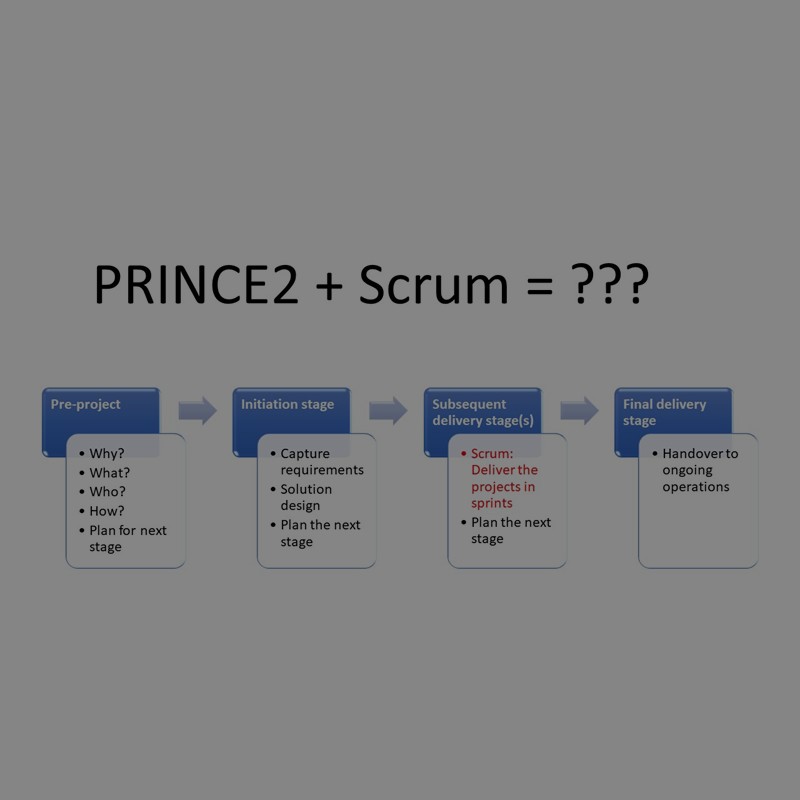
– manage by stages and sprints In this article I will provide you with examples on how you can combine Scrum and PRINCE2. This is what you could call hybrid project management. How do you manage a project that delivers a customized web portal or a smartphone app? Some might say: “Go agile – use Scrum to ensure you can go live with the first version as fast as possible” Others may say: “You need to get a quote from the different suppliers and get a fixed price to ensure you control scope and cost.” Both statements make sense, but you can also go for a hybrid approach where you combine Scrum and PRINCE2 in a way that is optimized to fit your project environment and risk appetite. Manage by stages PRINCE2 promotes the “manage by stage” principle. The figure below is highly inspired by PRINCE2 and shows the phases in a PRINCE2 project, but I have added “Deliver the projects in sprints” in the “Subsequent delivery stage(s)” phase. Here is an overview of what happens in each phase: The pre-project is used to define why we deliver the project, what we plan to deliver, who will deliver and how we will deliver the project. The initiation stage is used to capture the requirements and design the solution. If you have a high-risk appetite, the requirements can be a simple list of user story names. The user story names can be used as Scrum product backlog items for the subsequent delivery stages. If you want to reduce the risk, you can spend more resources and time in this phase making detailed requirements and/or prototypes. In the subsequent delivery stage or stages, you will deliver the project’s products. This is where you can use Scrum for developing and delivering the products. In the final delivery stage, you handover the project to ongoing operations. How do you strike the right balance between risk and agility? It is not easy to strike the right balance between risk and agility. Here are two possible extremes: A: Make a brainstorm session with potential users and let them write down features on Post-it notes. When this is done you ask the users what the most important features are, and afterwards ask the development team what they can have ready at the end of the next two weeks’ sprint. B: Bring in UX experts, let them make an extensive field study, build prototypes, let users test the prototypes and capture all the requirements in detailed specifications. To top it all detailed acceptance criteria for each user story are documented. Let’s consider how the two extremes will work in different scenarios. App development in tough competition Consider the case where you are the owner of a small start up and you have an idea for a new app. There are a lot of other companies that could have the same idea. If you go for extreme B, there is a high risk that your competitors have the competing app live before you have finished collecting your requirements. Hence, I would recommend an approach similar to option A and use the opportunity to quote Reid Hoffman, the founder of LinkedIn: “If you are not embarrassed by the first version of your product, you’ve launched too late.” Delivery of specific requirements on a fixed date You work in a bank and their license to operate depends on the compliance portal that your project must deliver. The portal must go live before a certain date. In this case I would go for extreme B and make sure you have defined exactly what is the “Must Have” requirements before you start the first delivery stage. You can still use Scrum to deliver your fixed scope. But you need fixed requirements to ensure you deliver the must have requirements on time. Conclusion PRINCE2 and Scrum can be combined, but it is very important you tailor your approach to your project environment. Further reading My article is based on experience and the reference below: The free Scrum Guide https://scrumguides.org/ Book: “Managing successful projects with PRINEC2” by Axelos Book: “PRINCE2 Agile” by Axelos My article – “Can PRINCE2 be agile?” https://excelled-pm.dk/can-prince2-be-agile/ The MoSCoW prioritization method. https://en.wikipedia.org/wiki/MoSCoW_method

Hybrid project management  – manage by stages and sprints Read More »

Can PRINCE2 be agile?

Some people might claim that there is no need for project managers and classic project management like PRINCE2. You could say: “The future is agile and you need to embrace change and run projects that create disruption in the marked. For this you need agile methods such as Scrum or Kanban. In these methods the project manager is not needed.” In some cases this might be right, but it is important to remember that e.g. Scrum is designed for continuous improvement of an existing product or a technical platform. What happens in the scenario where you start from scratch? The customer doesn’t know exactly what they want, the needed product has never been built before, the deadline for go-live has already been set and the customer needs a price to get the budget approved. Here Scrum alone will not help you. You need a way to capture the scope of the project and the customer’s quality expectations. You need to be very good at managing change and communicating how changes will affect time, cost, quality, scope, risk and benefit. In this case you can get some guidance from the PRINCE2 Agile manual. PRINCE2 Agile highlights My background is that I started out as software developer and then changed to project management. Earlier this year i took a good PRINCE2 Agile course and the certification. Below I will outline some of the highlights in PRINCE2 Agile. Agile is not either or PRINCE2 Agile gives some good guidance on how you can combine agile methods with classic PRINCE2. The 7 PRINCE2 principles and the 7 PRINCE2 themes still exist. This means that the project board (also know as steering group) and the executive (also known as project sponsor) still governs the project. All the documents and logs that are part of a classic PRINCE2 project still exists, but they are more informal. E.g. the risk register can be yellow notes on the Scrum team’s “information radiator”. An information radiator can be a white board where the team shares important information. The life cycle of the project The high level project stages are still: Pre-project, Initiation stage, subsequent delivery stage(s) and final delivery stage. The PRINCE2 Agile manual gives some examples on how a stage plan can consist of several release plans. The release plan can consist of one or more sprints. It also explains how you can use a flow-based approach like Kanban that has no sprints. I will recommend that you focus on how you can show progress and have a clear agreement on how products/features are prioritized. And finally it is essential that you can show what consequences changes have on cost and deadlines. What to fix and what to flex? The manual has a very interesting section on how to manage the six aspects of the project. When I started out in project management there was only three aspects: time, cost and scope. PRINCE2 governs following six project aspects: time, cost, quality, scope, risk and benefit. Since a project by definition is unique and includes many uncertainties you can not fix all the aspects of the project. You need to be ready to flex on some of the aspects to handle changes, issues and new knowledge. PRINCE2 agile fixes time and cost, but some of the scope can change. They flex and fix the scope by prioritizing the products to be delivered. There are zero tolerance for the product that are essential and some of the products that are not essential might not be delivered. To get this to work all stakeholders must accept that “the customer does not need everything”. If you don’t get this acceptance an essential part of the agility is not present. Organization theme When I first got to PRINCE2 Agile manual I skipped the first 70 pages and jumped right to the organization theme. I was hoping to find a mapping between Scrum roles and PRINCE2 roles. But I was a bit disappointed that there was no easy solutions. There are no changes in the PRINCE2 project organization, roles and responsibilities. But there is several good suggestions on how you can try to map PRINCE2 roles and Scrum roles. The senior user, that is part of the project board, will often end up being a lead product owner that has several product owners placed in different project teams. From my point of view the role that is most complicated to map is the PRINCE2 team manager. The PRINCE2 team manager has the following areas of responsibility: Planning Monitoring and managing progress Liaising with project managers and other stakeholders Final acceptance and handover of products A good Scrum master can take the team manager role, but if he should be true to the agile values he will cover the responsibilities by a mixture of delegating and facilitating. On a small project the project manager, the team manager and SCRUM master can be the same person. My experience is that an agile project manager with an experienced agile team will spend very little time managing and more time facilitating and coaching. The agilometer The manual includes a tool called the agilometer. It has six “suitability sliders” e.g. ease of communication and level of collaboration. Before you start your project you can use it to assess your project environment to verify if it is suitable for introducing agile concepts. If you are already running a project you can use it to highlight what you can improve to become more agile. You can try it out here: Are You Ready to Go Agile? Take the Agilometer Test  Conclusion This article outlines some of the high lights of PRINCE2 Agile from my point of view, and I hope it has inspired you to learn more. Implementing agile methods is not simple nor easy, but it can be done if you take small steps towards improvement every day. If there is low acceptance of agile methods in your project environment you have to be very careful with what agile concepts you

Can PRINCE2 be agile? Read More »