Without Losing Your Mind or Your Reputation
You’ve just been asked to take over a project. Maybe you’re new in the company. Maybe you’ve never worked with this type of project before. Maybe you’re quietly thinking:
“Am I too inexperienced for this?”
Or maybe:
“Am I too old to start over with a new way of working?”
The sponsor is watching. The team expects direction. The project is already rolling.
You’re now the project manager. And people expect you to make it work.
You need to get the team aligned. Understand what the project is really about. See if the plan is realistic. Figure out what the real risks are. And you need to do it fast.
When you start doing that – even just the basics – the team and stakeholders will start to trust you. They’ll see you’re the right person for the job.
1. Define Your Leadership – Before the Project Even Starts
This is something you can do right now. Even if you haven’t been assigned a project yet.
Ask yourself:
What kind of project manager do I want to be known as?
Are you the one who builds trust fast?
Who brings structure?
Who keeps things moving when others hesitate?
You don’t need 20 years of experience to lead. But you do need clarity. If you’re unclear, people won’t follow you. And if you don’t define your role, others will do it for you – and you may not like how.
“Clarity, alignment, stable progress. If we can’t deliver, we act early.”
(That’s my personal model. Find yours.)
2. Understand the Role You’re Actually Taking On
Every company has a different view of what a project manager is.
Don’t assume you’ll be doing the same as last time. Ask what’s expected of you:
- Are you responsible for delivery or coordination?
- Do you own the scope, or just the schedule?
- What decisions can you make alone?
- Who really has the power in the room?
Check the governance model. Talk to the sponsor. Ask the PMO. Align expectations early. It’s hard to correct course once you’re deep in.
💡Pro tip: Be ready to compensate for areas where you can see the project’s governance model is weak, such as business change management or testing.
3. Don’t Focus on Long-Term Plans. Deliver a Quick Win
Every project handover is different. And some are messy.
You don’t have time to rewrite everything. But you do have time to find small wins.
Here’s how I approach the first four weeks:
- Week 1: Listen. Watch. Absorb.
- Week 2: Clarify scope. Align with sponsor. Build trust.
- Week 3: Take action. Simplify. Show results.
- Week 4: Adjust and improve based on feedback.
The most important thing: create momentum. Get something done. Something visible.
People don’t trust ideas. They trust action.
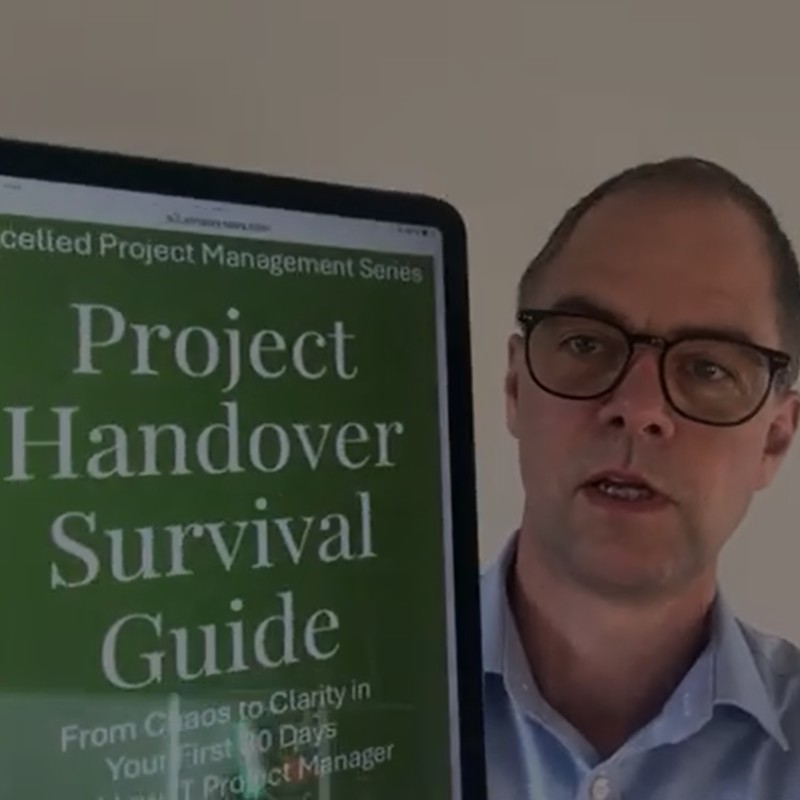
In my book, “The Project Handover Survival Guide”, I go through this process step-by-step – including tools, checklists, and examples from the field.
Here’s what you’ll also find:
- Appendix: IPMA-Based Complexity Assessment: Use it to assess if your project needs more resources – and explain it clearly to stakeholders.
- Appendix: How to Use AI Tools in Projects: Practical advice. No hype. Just ways to save time and stay ahead.
- Templates for Handovers and Introductions: Emails, summaries, meeting plans. Copy, paste, adjust – and move forward.
Why I Wrote the Book
I wrote this book because it’s the book I wish I had when I took over my first real project. I learned the hard way. I made the mistakes. I’ve seen what works – and what doesn’t.
I don’t want you to repeat my mistakes. I want you to start stronger.
Ready to Take Over Your Next Project?
Taking over a running project is hard. But it’s also one of the fastest ways to prove your value.